What are blue-green algae?
Blue-green algae, also known as cyanobacteria, are bacteria that naturally occur in bodies of water.
They owe their name to a blue pigment.
Their explosive reproduction is referred to as an algal bloom or water bloom.
When and where can blue-green algae occur in bathing waters?
Blue-green algae occur either freely suspended in the water (planktonic) or attached to solid substrates such as plants or stones (benthic).
An excess supply of nutrients (phosphorus and nitrogen), persistently high temperatures and strong sunlight provide optimal conditions for the growth of planktonic blue-green algae. Particularly during midsummer periods with continuously very warm temperatures, explosive and sudden growth may occur.
Blue-green algae are often washed ashore or accumulate near the shoreline and in bays (surface scum, algal mats).
Their occurrence at bathing areas strongly depends on wind and weather conditions. As a result, the local situation may change within only a few hours or days.
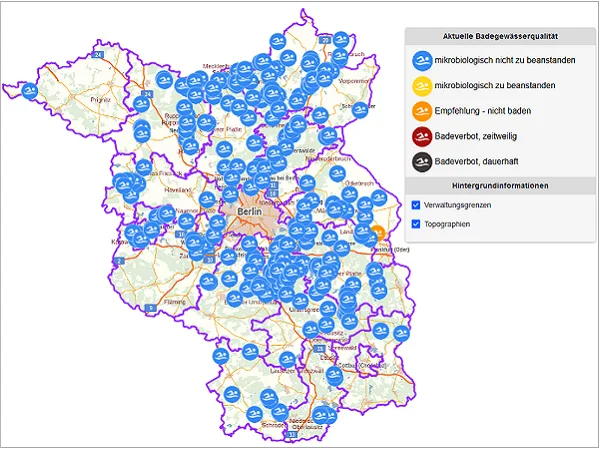
Blue-green algae can accumulate more easily in smaller bays. In general, the use of official EU bathing sites is recommended: https://badestellen.brandenburg.de/
Are blue-green algae dangerous?
Most types of blue-green algae are harmless to humans.
Their decomposition may cause an unpleasant smell.
Only a few cyanobacteria species can produce toxins.
An accumulation of these toxic cyanobacteria may pose a health risk to swimmers.
The greatest risk comes from oral intake, meaning swallowing larger quantities of water containing toxic algal blooms.
Children are particularly at risk due to their play behaviour near the shoreline and frequent hand-to-mouth contact.
Intensive skin contact may cause skin irritation or allergic reactions.
In addition, reduced visibility depths increase the risk of injury. Rescue measures may also become more difficult as a result.
Dogs and other warm-blooded animals are also at risk (through skin contact and drinking).
How can I recognise blue-green algae?
Possible signs include:
greenish or blue-green discolouration of the water
bluish-green or reddish-brown streaks or cloud-like accumulations
creamy-looking mats on the surface or cloud-like distribution in the water
low visibility depth (less than one metre)
If your own feet are barely visible in knee-deep water, you should not swim there.
Can I always recognise blue-green algae with the naked eye?
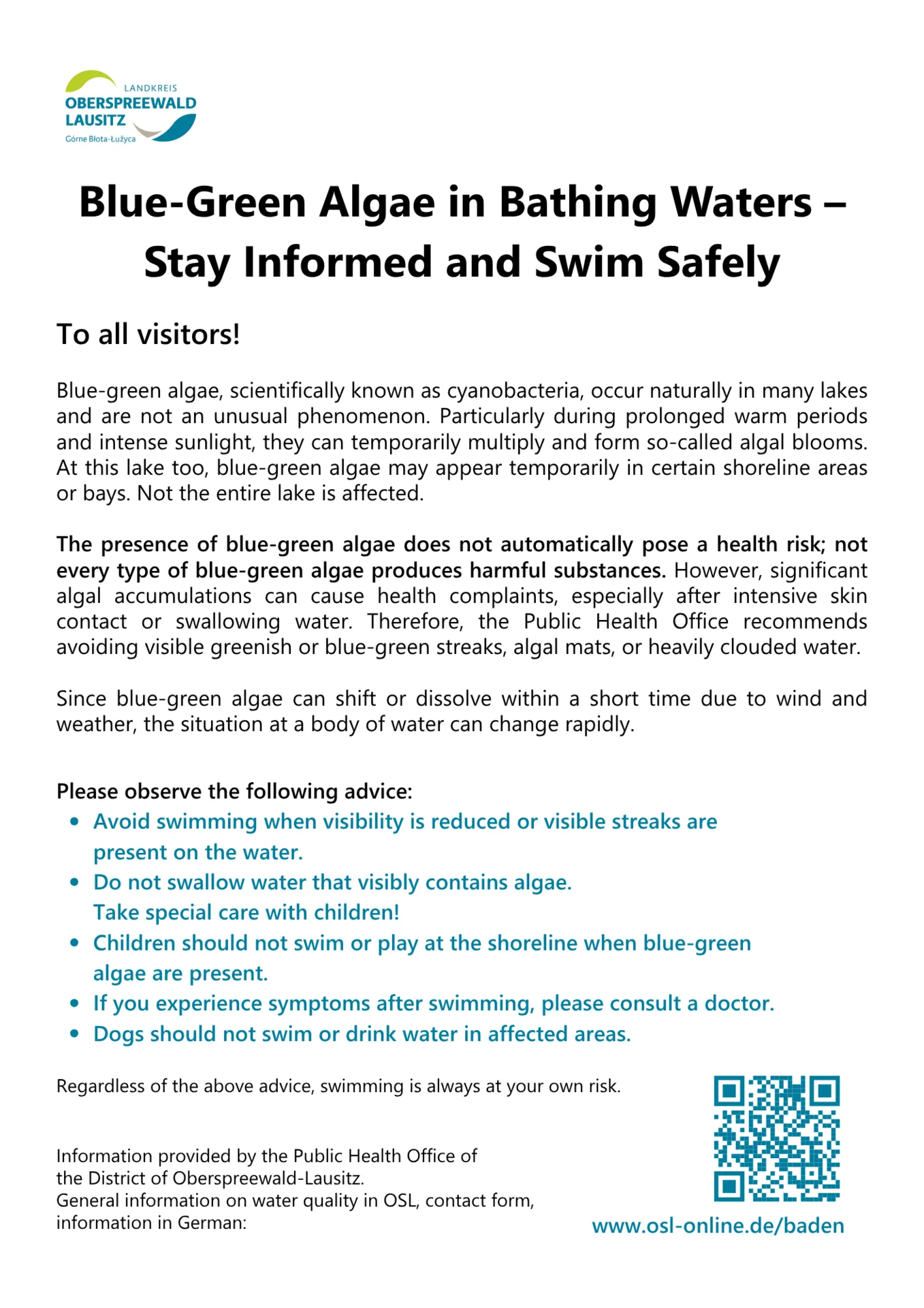
Not always. Clearly visible blue-green algae blooms (streaks/mats) can usually be recognised. If there is uncertainty, the general safety recommendations issued by the district should be followed.
Does this affect the entire body of water/lake?
No. Blue-green algae usually occur only in individual shoreline areas or bays. Wind and currents can move them within just a few hours.
Can the situation change at short notice?
Yes. Wind, sunlight and weather conditions significantly influence the distribution of blue-green algae. Therefore, the situation can change within a short period of time.
How long does a blue-green algae bloom last?
This cannot be predicted. The duration and extent depend largely on weather conditions and nutrient availability.
Regardless of the above information, swimming is always at your own risk.